REVIEW: Violent Skies | T.J. Lockwood 19 January 2018
Posted by Camille Gooderham Campbell in Book Reviews.Tags: debut, indie author, science fiction, T.J. Lockwood, Violent Skies, YVR Arts
add a comment
 While I usually prefer my science fiction reading to fall a bit more on the optimistic side, there are exceptions to everything, and this sharp and gritty debut novel from T.J. Lockwood stands out in all the right ways.
Violent Skies delivers a vividly dystopian world of flying (and once-flying) cities, nanobot addiction, and factions with conflicting interests. The strong female narrator/protagonist is a courier with a hidden purpose and layers of complexity that are slowly revealed as the story progresses. The intricate and well-thought-out technology supports the plot and world, and I found the use of biotechnology particularly interesting.
Overall, this is an engaging read, perfect for readers of darker science fiction — don’t expect any fluffy romance or uplifting inspirational messages. There’s some violence, so it’s probably not well suited for younger teens.
A new edition of Violent Skies will be released by Mecha Panda Publishing on February 1, 2018. The first edition was briefly available from Filidh Publishing in 2017.
REVIEW: The Scattered Bond (Shkode #3) | E.D.E. Bell 9 June 2017
Posted by Camille Gooderham Campbell in Book Reviews.Tags: book series, dragons, E.D.E. Bell, fantasy
add a comment
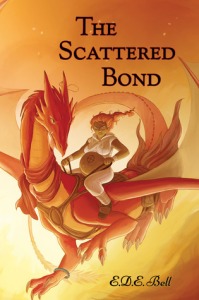 I love books about dragons, so my bar for this is set high, and E.D.E Bell’s Shkode Trilogy clears it with room to spare. Her dragons have a fully-realized society on a par with the world’s human society, and the problems and complexities of dragon life are given the same weight as the human issues at play.
The Scattered Bond wraps up the trilogy in a satisfying manner, with a dramatic climax and a solid conclusion to the various threads of the story. This is definitely a trilogy that needs to be read in order and in full (I would not suggest trying to read The Scattered Bond as a stand-alone).
The book and series feature some characters who are vegan, and that viewpoint certainly gave me a lot to think about. I adored the progressive and powerful female characters, and the theme of peaceful protest and speaking out against repressive authority.
If asked, I don’t think I could choose a “favourite” character or storyline, as they’re all so intertwined and vivid, but I do find myself particularly fond of Jwala and Atesh, the Kings, and of course Cor.
Start by reading the first book in the series, The Banished Craft — you have plenty of time to read it and The Fettered Flame before The Scattered Bond is released on September 1, 2017.
What About Wattpad? 21 September 2015
Posted by Camille Gooderham Campbell in Happiness, Publishing Industry.Tags: Wattpad
1 comment so far
Have you heard about Wattpad? For those who grew up with traditional publishing, it’s a bit of a different cup of tea.
When I first heard about it, I was… hmm… not happy? It was launched a year before Every Day Fiction was born, but it didn’t cross my personal radar until after we’d started running with the concept of novel serialization, and where we hoped to attract paying subscribers for our novelists, here was a site where anyone could just give serial installments away for free.
Smut, I thought. Fan fiction. People who couldn’t find publishers. (Bear in mind this was before indie publishing had gained status as a respectable choice for those willing to hire professionals and put in the hard work.) When I heard Margaret Atwood had embraced Wattpad, I felt betrayed. Support small presses and money for authors, not this… thing. But she, and Wattpad, were just ahead of the curve.
Since we’ve learned that readers don’t generally want to pay for serials, it appears the choice isn’t between Wattpad and paid subscription — it’s between Wattpad and serializing free on your own blog, or not doing it at all. And Wattpad offers a community of over 40 million people plus an established platform to handle new-chapter-up notifications, comments, votes, and reading lists.
The business of writing and publishing is in mad flux and probably will be for some time, but it’s becoming increasingly clear that the primary burden of promotion and brand-building is falling on the author, regardless of whether one is following the traditional route, the indie route, or a hybrid of the two. Building a toolkit of ways to reach out to new and existing readers is essential.
These days, I’ve completely reversed my original opinion of Wattpad.
As a platform, a brand-building and networking tool, it has a lot to offer: here’s a blog post by indie author Katie Cross sharing her experience, complete with stats and graphs. And this article/podcast on The Creative Penn has an answer to the question of how Wattpad helps to sell books: “It’s about building a fan-base for your writing, as opposed to your tweets or blog posts.”
No cat pictures, no memes, no linkbait — just stories. Yes, there’s plenty of smut, and fan fiction, and doubtless some people who couldn’t find publishers. There are also established traditional-path authors, rising-star indies, a globe-spanning community, and every kind of writing you can imagine (not just fiction, either; I’ve found poetry and self-improvement advice). It’s hotter for some genres than others, and apparently has a demographic tilt toward readers who are female and under 35, but it’s been great for me so far.
I’m currently serializing a novelette on Wattpad under my pen name, and I’m absolutely thrilled with the experience. Words like empowering and addictive and fun come to mind. I specifically chose to do this with a project that I wanted to give away, to start developing a world I’ll write further in (and building a fanbase for that world).
I expect that more experienced authors will be divided on the merits of Wattpad, just as there tends to be a divide at a certain level over whether to continue submitting to token-paying markets once one can command a semi-pro rate. As always, my feeling is that it’s an individual author decision: you have to weigh the costs (lost income opportunity, sacrifice of prestige, time) against the benefits (brand extension, networking, enjoyment) and do what’s right for your own journey.
Making Your E-Book Beautiful 13 August 2015
Posted by Camille Gooderham Campbell in E-book Production.Tags: e-book production, e-books, publishing services, walkthrough
add a comment
Have you ever wondered what goes into making an e-book? Or why some e-books look like Word documents that someone shook a little and slapped a cover on, while others look sleek and smart and pretty? Here’s a little piece I wrote over at my E-books Done Right website:
Making Your E-book Beautiful: The Steps We Take
Behind the Scenes with
Bon Bons to Yoga Pants by Katie Cross
Sometimes it’s the smallest details that take an e-book from just ordinary to something special. Let’s walk through the production process with a recent project: Bon Bons to Yoga Pants is the fifth book I’ve produced for indie author Katie Cross, but it’s the first one in a new genre and new series for her.
When a new project is on the virtual table, the first thing we have to establish is the stylesheet. How big…
I hope you enjoy this walk-through of the process with a book that was great to work on for a whole bunch of reasons (includes links to some fabulous publishing services people). And if you have any questions about e-book production, feel free to ask.
REVIEW: Someone Else’s Skin | Sarah Hilary 27 February 2014
Posted by Camille Gooderham Campbell in Book Reviews.3 comments
I knew from the first time I read one of Sarah Hilary’s flash fiction stories (“Lolita’s Lynch Mob“, back in 2007) that she’d be someone to watch. I was not surprised at all to hear that she’d got an agent and then a book deal — and I was thrilled to bits when an advance review copy of Someone Else’s Skin arrived in the mail.
 I was not disappointed. Rather, I was blown away. I knew it would be good, but it exceeded my already-high expectations; I was gripped from the first sentence, and barely glanced up from its pages right through to the last line. It’s one of the best books I’ve read, regardless of genre.
The prose is flat out gorgeous, but you don’t really slow down enough to notice it… on a first reading anyway — I appreciated the style and power of the language more fully on a second reading, once I wasn’t totally focused on finding out what would happen. There are no wasted words in this book; it’s as clean and fluid as the best sort of flash fiction, all the way through.
DI Marnie Rome is a protagonist with layers and staying power — I can well imagine that I’ll still be engaged with her and finding out new things about her through book after book. I also really connected with her partner/subordinate DS Noah Jake (and it’s refreshing to have a major character whose ethnicity and sexual orientation is a natural part of the story, without it being either a soapbox issue or tokenism). The suspects and victims are intricately detailed, as are many of the other law enforcement and social services officials — no cardboard characters here.
Someone Else’s Skin doesn’t shy away from difficult or uncomfortable subject matter; much of the story is set in a women’s shelter and deals with domestic violence in an increasingly multicultural modern London, the crimes are somewhat gruesome in nature, and the novel gets into some pretty dark and twisted places. None of it feels forced or done for effect, though; the story flows to an almost inevitable conclusion, one that had me cheering aloud. It’s also a book for intelligent readers, thankfully, and doesn’t spoon-feed information or telegraph the plot.
Bottom line, and my first thought on putting the book down after I finished reading it: I need the next book in the series, right now. It’s that good. Five stars, for sure, and a permanent place on my read-again-and-keep-forever shelf.
Thank you to Headline Books for sending me an advance review copy. Someone Else’s Skin is released in the UK today (get it HERE!) but won’t be out in North America until June. It might just be worth paying the overseas shipping so you don’t have to wait…
UPDATE (June 24, 2014): Someone Else’s Skin is now available in North America! Get it at Amazon, Amazon Canada, Chapters Indigo, Powell’s Books, or shop IndieBound.
Writing Tips Are Like Diet Advice 15 January 2014
Posted by Camille Gooderham Campbell in Advice For Writers.4 comments
If there were a magic solution for dissolving avoirdupoids — a secret formula that really worked, for everyone, without other factors and regardless of life’s complications — we’d all have movie-star bodies. And if there were a secret formula for perfect, readable, saleable prose, there’d be no writer left behind. The fact is, no magic combination of kill-the-adjectives and active voice will automatically perfect your writing, any more than grapefruit-cucumber milkshakes or an all-protein diet will make you thin.
It’s a good idea to learn the rules before you break them, in the same way that learning about calories and nutrition and exercise can help you become healthier and stronger. Understanding grammar is good. Figuring out what said-bookisms are (and why modifiers should be used sparingly, and why the active voice is generally stronger than the passive voice, and what that show-don’t-tell thing means, etc.) is even better.
But then… you have to read. And read, and read. Read the best writing you can find, in as many genres as you’re willing to try. This is like eating good stuff. And all that great writing, and the techniques and style therein, are absorbed into your brain. It fuels your writing just like healthy and varied meals fuel your body. There’s no secret reading list that will set you right up, of course, any more than there’s one perfect meal plan for everyone. We all need to find our own way, with variety and balance and experimentation, and even occasional guilty pleasures — you won’t stick to reading any more than you’ll stick to a diet if it’s an unpleasant bore.
(Oh? Don’t have time to read because you’re “too busy writing”? Isn’t that essentially starving your writing rather than feeding it, sacrificing long-term development in favour of short-term gains? Sure, it’s fine in temporary bursts, but how many literary meals can you skip before you start losing writerly muscle mass and energy?)
And of course, you write. It’s like doing push-ups; you’re maybe in poor shape at first and can barely get yourself off the floor, but start doing more and more, regularly, and one day you realize that you’ve gotten all strong and toned and whatnot. There’s no substitute for doing the work.
The most entertaining similarity is that literary preaching is just as annoying as lifestyle-and-diet preaching. Think about it; in both of these areas — where no two people are the same, where the measure of success changes from person to person and even from day to day, where getting it right involves endless trial-and-error, learning, experimentation, hope, small successes and failures, and ongoing hard work — it’s intensely irritating to hear “you’re doing it wrong” and “if you’d only do it my way you’d get a better result”. (Also, anyone who doesn’t know the difference between preaching and discussing is probably beyond help.)
Ultimately, we’re all entitled to choose what our own goals are, and what means success to us, right? So I don’t get to tell you what your body ought to look like, what I think you should eat, what makes you beautiful to yourself and those who love you. I’m pretty sure that, likewise, your literary voice can be unique and awesome in so many ways that might not fit with what I currently see as perfection. If I choose to be judgmental about the way you look (and yes, that’s hypothetical… we all try not to do that, right?) or the way you write (um, possibly guilty, depending on who you are?), that’s on me. As an editor, I can tell you what I want and don’t want to see, but only with regard to magazine and book projects I control; as a reader, I can only choose what books to buy or not buy, and how to spend my reading time. But you’re still free to choose your own path.
A Unique Redefinition of… Something 26 July 2013
Posted by Camille Gooderham Campbell in Hall of Shame.11 comments
We don’t ban people from submitting stories to Every Day Fiction often. Hardly at all, in fact. I could count them on one hand over the past… well, almost seven years now.
But when someone refuses to see the conflict between unattributed chunks of text quoted without permission (from an online non-fiction article about the story’s subject) and item 6(a) of our contract — “The Author represents and warrants that he/she is the sole author of the Work, that the Work is original and not previously published, and that the Work does not, to the best of his/her knowledge, infringe any third party’s copyright, trademark or other proprietary rights.” — we don’t really have any other choice. How could we ever trust any submission from this person who refuses to see that appropriating someone else’s text is wrong?
The reaction? Apparently a ban is “over the top” and we need to “get rid of what they taught you in school about literature, and start using you own minds.”
The justification we were given as to why it’s okay to use other people’s words? “I did not invent words either, so, according to your logic, whoever uses words is not a fiction writer.”
Also, this: “I do it all the time, it’s my definition of the 21st century writing, which I define, not the century.”
This one goes in the Hall of Shame, for sure.
Your Past May Be Out There 30 June 2013
Posted by Camille Gooderham Campbell in Random Thoughts.Tags: Google, online presence
add a comment
Today I discovered that I still have a MySpace profile. Remember MySpace?
It was under an old email address to which I no longer have access, so I’m lucky I was able to make an educated guess at the password and get in to sweep away the cobwebs and tidy the place up. A bit of dust gathers after seven years, you know?
So… do you have old profiles hanging around forgotten on the interwebs? And do they represent who you are now?
When the world moves on from a site or service, it’s easy to lose track of what might still be around. And as you develop in your life and career, you’re probably not the same person you were a decade ago (at the superficial level of profile pictures and status updates and bands you liked and so on). But if someone is curious about you — a potential employer, publisher, reader, fan, romantic prospect, new friend, or someone you admire — a tiny pinch of Google-fu can turn up all kinds of odd things…
And… I just found my forgotten first blog, not updated since 2007. Great.
(Now you’re going to go Google yourself, right? Tell me if you find any surprises…)
Here’s A Tip: Be Someone We Want To Work With 20 April 2013
Posted by Camille Gooderham Campbell in Advice For Writers.11 comments
I’m not going to review the obvious here — reading guidelines, polishing and proofreading your work, etc. — on the assumption that you’ve already got it covered. This is about how to be someone an editor wants to work with.
Let’s start by assuming that you’re a good (or at least competent) writer, able to produce work at a level suitable for the magazine or publishing house you want to build a relationship with. No amount of schmoozing or game-playing is going to get you there if you’re not up to standard; there’s no secret way around that. And, fortunately or unfortunately, you still need to get noticed by the editors (whether with an acceptance, a revision request, or an “encouraging” rejection that indicates interest in seeing more of your work) on the strength of your writing. But from there, you can become a writer editors see as a pleasure to work with, or a kind of neutral entity who doesn’t trigger any thoughts one way or another, or a writer at whose name editors roll their eyes and shudder.
It’s not so much of an issue if you’re a brilliant master of the craft and rolling in awards and praise in all directions — editors will put up with a lot (though not everything or indefinitely) for the reward of genius-level work to publish (and hopefully profits to go with that, if we’re talking actual books for sale or paid subscriptions). It’s also true that nothing will save you if you can’t write.
But when you’re at a journeyman level, working your way up from more-than-competent to potential-star-on-the-rise, you’re most likely submitting work to places that get more acceptable-quality submissions than they have publication spots. So it stands to reason that you want to have every possible advantage on your side. You want editors to see your name and smile, to think, “Oh, yes, I like working with that one.”
How to make editors smile
- Regular, ongoing submissions are the best way to show that you’re really interested in being part of a magazine. Don’t give up after one rejection. Learn from the feedback you get, and keep trying. I can think of many instances where an acceptance came after four or five rejections, as the author got closer and closer to what we look for. By the time you get there, we feel like we know you, and we’re cheering for your success.
- Have a professional-looking, genre-appropriate, up-to-date blog or website. This really is the first place most people will check for more information about you, and that includes editors who’ve noticed you and want to learn more. A polished website (especially one with a nice list of recent publications and updated news) goes a long way to cementing any positive first impressions you may already have achieved.
- Our confidence in you increases when you consistently behave in a professional manner. This isn’t a one-time thing or a badge earned, it’s more of a growing assumption based on a past record — we know the plagiarism & previous publication check will come up clean, we know you’ll respond promptly to a revision request or other correspondence, we know if/how you’ll interact with readers once your story is published, etc.
- Editors like to feel appreciated. Not in a fake formal-thank-you-note way, and I don’t think there’s any specific technique or set of instructions for how to “do it right”, but genuine appreciation makes a natural impact, so don’t be shy to show it if you feel it.
- Social media groups and communities are a great way to get to know your editors and let us get to know you beyond routine correspondence, without the risk of imposing as you might with personal emails or friend requests that come too soon. It’s not wrong to send an editor a Facebook friend request or an email about something that isn’t strictly business, but there’s a very fine difference between slowly developing a connection and rushing forward at an inappropriate pace. Personally, I’m always thrilled to get to know writers at any level, but I feel better if I’ve had some discussion/interaction with you before I get that friend request or your quarterly writing news email.
- Be a fan! It’s tried-and-true advice to read a few issues of a magazine (or a few books from an imprint) before you submit your work — but there’s an ocean of difference between having looked over a couple of “representative samples” and being a follower/fan/subscriber/reader/participant. When someone wants to be a part of our community and what we do, as opposed to just having us on a list of a few dozen potential markets, it’s only natural that we’ll want to help make that happen. It may mean extra feedback from the editorial team, or improved likelihood of getting a revision request instead of a rejection for something that might be close — these are the two biggest areas where fractional impressions can influence what we do: the amount of time and care spent on crafting editorial notes, and the moment of wavering between an outright rejection and a chance to rewrite.
- We love our volunteers. Most magazines and smaller publishing houses depend heavily on volunteers, and no matter where you live or what your background and skills are, there’s almost always something you can do to help. It never hurts to offer your time and talents, and see what can grow from that.
- Be (or at least act) sane and pleasant. All else aside, if you seem like a decent human being, we’ll probably enjoy whatever contact we have with you.
Now, I’m in no way suggesting that writers need to be all sweet and agreeable and self-effacing to be liked — “pleasant” basically means that we don’t walk away from a conversation with you thinking ugh, that was a bad scene. Editors aren’t infallible and good ones should be reasonable; if you don’t want to make changes to accommodate an editor’s opinion, you can be firm (and if publication is contingent on you making particular changes, you can always respectfully decline and take the piece elsewhere, with no harm done). The point is not to argue with your editor, but to explain your concerns and see if there’s a solution that will satisfy everyone.
A writing career is a long-term thing, and nothing is gained from short-term “victories” if you’re the only one feeling good about them.
How to make editors shudder
- When you receive editorial feedback on a story, whether accepted or rejected, email us to justify your choices, explain what we should have understood from your story, and show your disdain for any revision suggestions. I’m not sure which version of this is less appealing: the overtly arrogant challenge or the self-deprecating humblebrag.
- Be precious about your deathless prose and strongly object to seeing the least punctuation mark or verb tense adjusted, even when it’s grammatically wrong. Dish out attitude to anyone who wrongfully corrects a misused semi-colon for you. Ferociously defend every adverb.
- Submit previously published work as unpublished, especially if the original publication isn’t available online to be found by a Google search. If asked about it, lie: why, that review must have been written by a friend who was emailed the story, mistakenly thinking it had been published somewhere, right? For advanced credit, submit the same story to us multiple times, on the assumption that we won’t recognize it from the time before. If you can’t deliver previously published work of your own, consider plagiarizing from sources such as Moby Dick.
- Ignore guidelines about no simultaneous submissions, and routinely withdraw stories because they’ve been accepted elsewhere, or wait until you receive a rejection or acceptance to let us know that actually the story isn’t still available. When the no-sim-subs rule is politely mentioned, rant about how refusing simultaneous submissions is being controlling and denying writers the opportunity to seek the best deal for their stories.
- Send queries that completely ignore any nicety of salutation or courtesy: “When will I get a response about my story?” Don’t include any useful information such as the title of your story or when you submitted it. Don’t check the submission guidelines or FAQ page to see if the answer is readily available.
- Respond to rejections with emails full of anger, swearing, denigration of the magazine or publishing house and its editors, threats, hatred, etc. For bonus points, make accusations of bias, prejudice, and/or cronyism. Then go gripe about us to your online writers’ forum.
- Troll the comment threads of other people’s published stories, looking to start arguments and cut down other writers. Make cutting remarks about the editors’ choices and skills. Create sock puppets to agree with you and add to the fun. Learn the publication’s commenting guidelines so you can stay just barely on the right side of them, giving moderators no technical grounds on which to expunge your venom.
- Be a loose cannon on your blog and social media, and don’t restrict your posts to just friends either. Make every disagreement public and unpleasant; name names, point fingers. Get into drag-out arguments on sensitive topics. Self-promote aggressively and offensively. Overshare personal drama and private business. Turn your “author platform” into a polarized battleground full of political and social minefields.
In terms of public persona, there are several successful writer-bloggers who take strong stances about various things and aren’t known for pulling their punches, and usually editors want to work with writers who are passionate, who are willing to stand up for issues that matter to them, who enjoy engaging with the wider community and aren’t afraid of a spicy debate. The thing is, spicy debate is elite-level stuff — if you’re still trying to work out where the line is between wit and vitriol, if you’re wondering why your public persona shouldn’t necessarily extend to your business communication, or if you’re not sure what makes a comment “inappropriate” or “offensive” instead of “daring” or “edgy”, you’re not there yet.
Finally, as to being sane… I believe it was F. Scott Fitzgerald who said good writers are “a whole lot of people trying so hard to be one person” (in The Love of the Last Tycoon), so I totally get that ‘sane’ may be a negotiable term at times. But you know, quirky is just fine. Eccentric is fine. Tortured and melancholic are unfortunate for you but fine for us. Just… don’t be a psychopath, okay? You know what chaotic evil is? Don’t be that. Then we’re good.
Squee! I Can Make Animated GIFs! 28 January 2013
Posted by Camille Gooderham Campbell in Happiness.add a comment

Look at that! Stuff moves! It’s cool!
Seriously, though, I realize that everyone in the universe except for me can already make animated GIFs — there are enough of them out there to choke the internet, after all — but I’m a book designer and publisher: in my world, stuff stays still on the page.
Only… it doesn’t. E-book text reflows based on the e-reader’s screen and the requested font size, right? That’s movement. Plus, a fair chunk of what we publish is… online.
And today Jordan Ellinger pointed out to me that movement draws the eye. (I knew that; I just hadn’t thought about it in the context of animated ad banners.) Since I do up virtually all of our advertising and promotional material, I quickly realized that yes… this had to be figured out.
Turns out it was not difficult at all. All you need is Photoshop (I’ve got CS5.5). In case you too were with me in the Dark Ages of non-animation, here’s an excellent tutorial from Wired: http://howto.wired.com/wiki/Make_an_Animated_GIF (try the layer visibility method first, and then play with tweening once you’re comfortable).
So, do you like the speed my banner is animated at, or should I slow it down a little more?


 Copy. Edit. Proof.